
Fire Protection Water Tank Requirements & Material Options
Blog
Fire Protection Water Tank Requirements & Material Options
Fire protection water tank requirements are often overlooked, and we see this issue all too often on overseas projects: the fire water tank is bought on price and erected, then the fire consultant or the authority having jurisdiction (AHJ) rejects it at inspection. The usable volume is short, the overflow is undersized, the vent is missing, or the foundation cannot carry the full water load. Re‑ordering parts, re‑pouring a slab and delaying handover cost far more than the money saved on the quote.
The root cause is usually treating a fire tank as a bigger potable tank. A potable tank is designed around water quality: hygiene, food‑contact materials and turnover. A fire tank is designed around guaranteed availability: a fixed reserve volume, reliable pump suction, freeze protection, and a structure that stays standing when the building needs it most.
Core Fire Protection Water Tank Requirements
Standards differ by country and project. NFPA 22 (water tanks for private fire protection), NFPA 13 and NFPA 20 are common references in export markets, but local municipal codes, civil defence rules and insurer requirements often add conditions. Get the governing code from the project consultant in writing before the tank design is frozen.
Capacity and Fire Tank Capacity Calculation
Capacity comes from the system demand, not from a catalogue size. You need:
- The required flow rate, from the hazard classification and the sprinkler or hydrant design
- The required duration, commonly 30 to 120 minutes depending on hazard class and code
- Any hose stream or hydrant allowance
- Any extra reserve demanded by the consultant or insurer
The basic fire tank capacity calculation is: (sprinkler flow + hose allowance) × duration = usable volume. For example, a total demand of 1,500 L/min for 90 minutes requires 135 m³ of usable water. Then add the dead volume, meaning the water below the pump suction outlet or anti‑vortex level and above the overflow, to arrive at the nominal tank size. Always confirm that the quotation states usable volume, not just nominal volume.
Water Level, Overflow and Venting
- Level: Fit a level gauge, low and high level alarms, and auto‑fill. Position the suction outlet and anti‑vortex plate so the pumps never draw air.
- Overflow: Size it for the maximum inlet flow, with an insect screen, discharging to a safe drain. Never connect it directly into a closed drain line.
- Venting: The tank must breathe as pumps draw down. A blocked or missing vent can pull a vacuum on the walls and damage the structure.
Freeze Protection
Above‑ground tanks in cold climates need insulation and, where the code requires it, heating. Codes often set a minimum water temperature, so confirm the figure for your project. Insulate the inlet, outlet, level devices and valves too; a frozen float valve is as bad as a frozen tank.
Foundation and Structural Load
One cubic metre of water weighs one tonne. A 135 m³ tank puts more than 135 tonnes on the base, plus self‑weight, wind and seismic loads. The foundation must be designed by a structural engineer, kept within the flatness tolerance, and match the manufacturer’s support layout. We cover the most common site errors in [Grounding & Foundation Mistakes That Ruin Your Stainless Steel Sectional Tank].
Isolation and Protection
Dedicate the fire reserve. Any domestic or process draw‑off must be taken above the reserve level (for example via a raised standpipe) so normal use can never drain it.
Use lockable manholes and caged ladders, and protect the tank from vehicle impact.
Fire Water Tank Material Options Compared
Three constructions dominate fire storage projects. The right one depends on climate, site access, budget and local acceptance.
Bolted Stainless Steel Sectional Tanks (304 / 316)
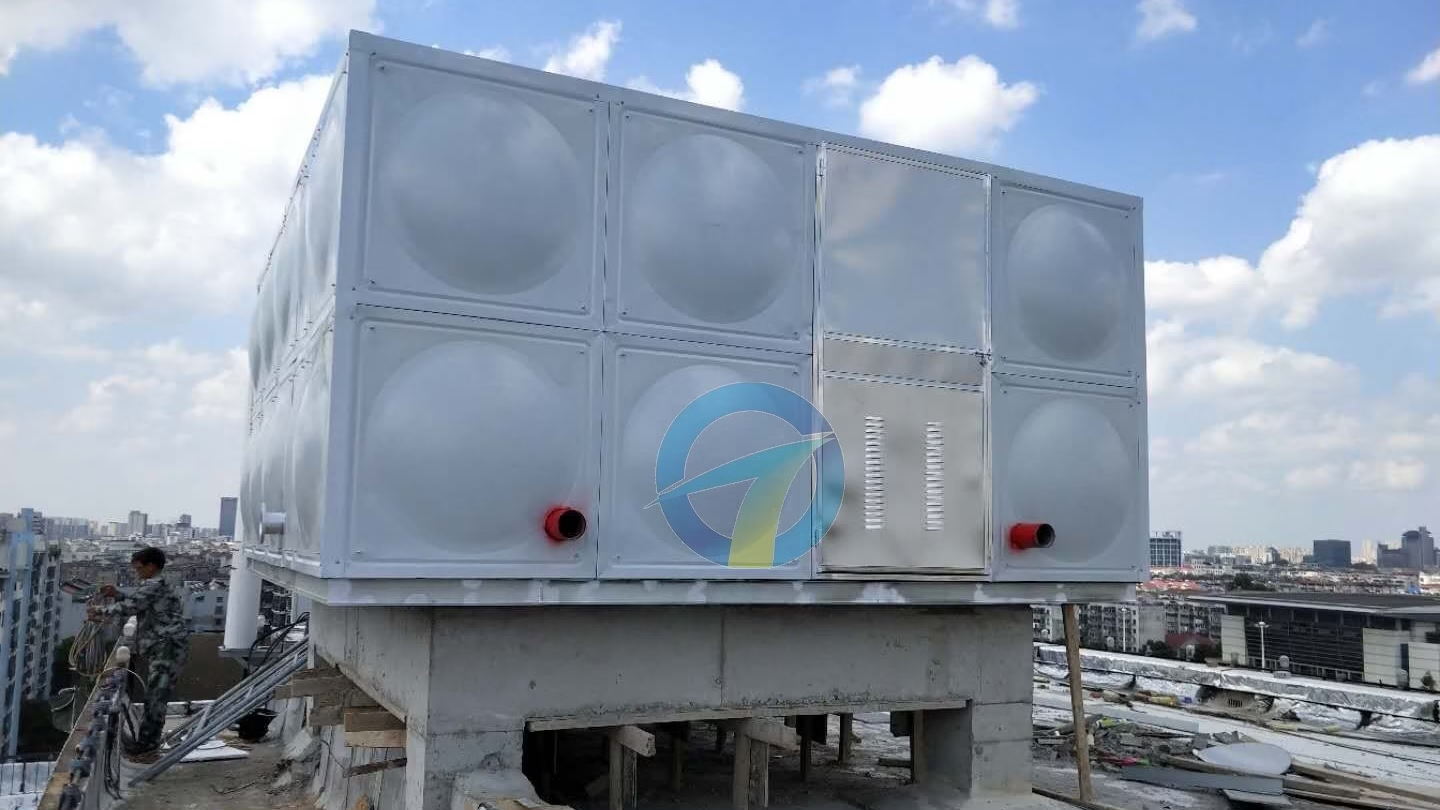
Pressed stainless panels are bolted together on site with sealing gaskets. They ship flat in containers, go up quickly with a small crew, and suit rooftops, plant rooms and remote sites. Grade 304 suits most inland, low‑chloride environments. Choose 316 for coastal sites, industrial atmospheres or any place chlorides are present. A stainless steel fire water tank has a good strength‑to‑weight ratio and is easy to inspect.
The trade‑offs are a higher material cost than GRP and a dependence on correct panel thickness, bracing and sealing. Maintenance is simple: check bolts, seals and the external finish at scheduled intervals. For thickness guidance, read [Water Tank Thickness Cheat: Why Thin Steel Tanks Fail Early].
GRP / FRP Sectional Tanks
A GRP fire tank is light and naturally corrosion‑proof, which makes it attractive for aggressive coastal sites and tight budgets. It is easy to handle and transport.
The short‑comings are real, though. GRP is combustible, so some AHJs and insurers restrict it near buildings or require specific approvals. UV exposure can degrade unprotected surfaces over the years. It is also less rigid than steel, so it needs careful support and is less forgiving in high‑wind or heavy‑seismic locations. Always check local acceptance before you specify it.
Welded Stainless Steel Tanks
A welded tank gives a smooth, continuous shell, which suits fixed installations in industrial plants. The downsides are weight, transport of large volumes, the need for qualified welders and post‑weld passivation on site, longer lead times, and difficult relocation.
Comparison Table
| Material | Service Life (typical) | Outdoor Corrosion Resistance | Weight | Cost | Maintenance Workload | Best‑Fit Fire Projects |
|---|---|---|---|---|---|---|
| Bolted SS 304 | 20–30 years | Good (inland, low chloride) | Medium | Medium | Low: periodic bolt and seal checks | Inland rooftops, plant rooms, general fire reserves |
| Bolted SS 316 | 25–30+ years | Excellent (coastal, industrial) | Medium | Medium‑high | Low | Ports, coastal sites, chemical and industrial areas |
| GRP / FRP | 15–25 years | Excellent against corrosion; UV and fire acceptance need checking | Light | Low‑medium | Low‑medium: surface and joint inspection | Budget‑sensitive sites where local code accepts GRP |
| Welded SS | 25+ years | Good to excellent (grade dependent) | Heavy | Medium‑high plus site labour | Low, but weld inspection needed | Fixed plant installations with skilled labour on site |
Service lives are typical figures under correct design and maintenance. Actual performance depends on grade, thickness, environment and installation quality.
Common Mistakes with Fire Water Tanks
- Using a potable tank as a fire tank. A domestic tank is rarely designed for reserve volume, dedicated suction, or fire inspection requirements. Reusing it usually fails review.
- Cutting plate thickness. Thin panels save money on the quote and fail in service through bulging, leakage and fatigue at the bolts. This is the cheapest way to lose a fire project.
- Ignoring freeze protection. The tank may be fine while the pipework and valves freeze, and that is enough to disable the system.
- Leaving out vent and overflow fittings. These are small items that get dropped in value engineering and then block acceptance.
- Substandard foundations. Uneven or under‑designed bases cause panel stress and leaks. They are also a leading reason tanks fail early.
Pre‑Project Checklist for Fire Water Tanks
Save this list and run through it before you send the RFQ.
- Governing fire code and AHJ requirements confirmed in writing
- Hazard class, required flow rate and duration confirmed
- Usable volume calculated, with dead volume and overflow level added
- Suction outlet, anti‑vortex plate and pump arrangement defined
- Level gauge, alarms and auto‑fill specified
- Overflow and vent sized, with screens and a safe discharge route
- Minimum design temperature and insulation or heating requirement set
- Material chosen against climate, chloride exposure and local acceptance
- Panel thickness and bracing confirmed by the manufacturer
- Foundation drawing issued with full water load, wind and seismic data
- Fire reserve separated from any domestic or process draw‑off
- Access, ladders, manholes and security features agreed
- Inspection and maintenance plan agreed with the owner
Get a Compliant Fire Tank Quotation
Every fire project has its own code, climate and site constraints. Share the numbers early and we can match the tank to them.
Send over your fire‑project parameters for our compliant quotation: [Get a Quote]
Include the governing standard, required usable volume, site location (coastal or inland), installation type (rooftop or ground), and any insulation or approval requirements.