
Segmented Water Tank: A Practical Guide for Engineers and Contractors
Blog
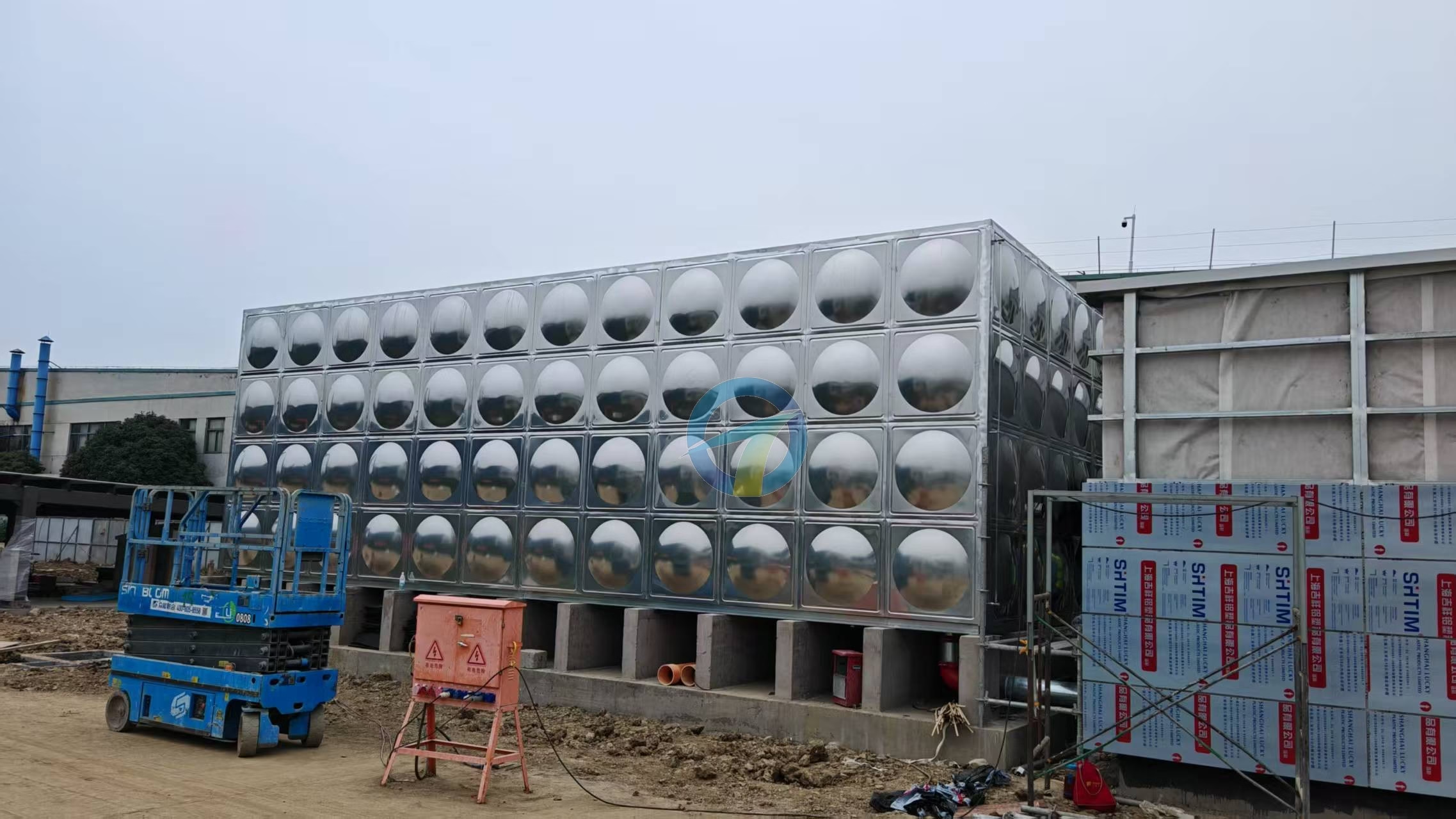
Segmented Water Tank: A Practical Guide for Engineers and Contractors
When a project needs potable water or fire-protection storage in a plant room, on a rooftop or at a remote site, the tank has to fit the access route as well as the design volume. A segmented water tank solves this by shipping as flat panels and being bolted together on site, so no crane lift of a finished vessel and no site welding are needed.
This guide explains what a segmented water tank is, how it compares with welded steel and GRP tanks, which materials are used, and what to confirm before you specify one.
What Is a Segmented Water Tank?
A segmented water tank is assembled from modular pressed panels, joined with bolts and sealed with gaskets or approved sealant. You may also see it called a sectional water tank or a bolted sectional water tank. When the panels are made of stainless steel, it is commonly described as a stainless steel panel tank.
Capacity is built by combining panels in length, width and height. Internal tie rods or external reinforcement carry the hydrostatic load, depending on the design. Because the system is modular, the same panel range can cover anything from a few cubic metres to several thousand, and the footprint can be adapted to irregular rooms or rooftop loading limits.
Segmented vs Welded vs GRP Water Tanks
| Factor | Segmented (stainless steel panel) | Site-welded steel | GRP (sectional) |
|---|---|---|---|
| Delivery | Flat-packed panels | Plates or a large prefabricated shell | Moulded panels |
| Site work | Bolting and sealing | Welding, grinding, passivation or coating | Bolting and sealing |
| Hot work on site | None | Required | None |
| Access needs | Panels fit lifts, doors and stairs | Often needs large openings or cranes | Panels fit standard access |
| Capacity changes later | Can be extended by adding panels (design permitting) | Difficult | Possible, depending on system |
| Internal surface | Smooth metal, corrosion resistant | Depends on coating or lining | Smooth, but resin and UV exposure need attention |
Welded tanks remain a valid choice where a single seamless vessel is specified and site conditions allow controlled welding and inspection. However, site welding adds hot-work permits, weld inspection and surface treatment to the programme.
GRP sectional tanks are light and widely used, but panel strength, resin quality and UV exposure must be managed. Opaque or covered designs are usually needed to limit algae growth. A stainless steel panel tank is generally opaque and does not rely on an internal coating for corrosion protection.
Materials: Stainless Steel Grades and Components
Most stainless steel segmented water tanks use one of two grades:
- AISI 304 (1.4301): suitable for most potable water applications with low chloride levels.
- AISI 316 / 316L (1.4401 / 1.4404): recommended for coastal sites, higher chloride content, or where disinfectants such as chlorine are dosed at elevated levels.
Panel thickness varies with water depth, so the lower rows are normally thicker than the upper ones. Always ask for a structural calculation showing how panel thickness, reinforcement and tie rods are sized for your specified height and load case.
The sealing material and any other wetted component are as important as the metal. For potable water, they should carry the approvals your market requires, for example WRAS in the UK, NSF/ANSI 61 in the United States, or AS/NZS 4020 in Australia. Ask the manufacturer for material certificates and approval documents for your project file.
Key Advantages of a Segmented Water Tank
Easy transport and access: modular panels can be carried through standard doorways, lifts and stairwells, which matters for refurbishment projects and congested sites. No hot work on site: bolted assembly avoids welding permits and reduces fire risk in occupied buildings. Flexible geometry: the tank can be sized to the available footprint and height, and compartments can be added to keep supply running during cleaning. Scalability: many designs allow capacity to be increased later by adding panels, subject to structural verification. Hygiene: a smooth stainless steel interior is easy to clean and does not require an internal coating. Maintenance: individual panels and gaskets can be inspected or replaced without removing the whole vessel.
Installation Overview
Installation is faster than for most site-built alternatives, but it needs a flat, properly designed base. A typical sequence is:
- Base preparation: a level concrete slab or steel support frame, with load capacity confirmed by the structural engineer.
- Floor panels: laid out and bolted with sealing strips or gaskets.
- Wall panels: assembled row by row, with bolts tightened to the manufacturer’s torque specification.
- Reinforcement: internal tie rods or external bracing fitted as the walls rise.
- Roof and fittings: cover, access manhole, vents, overflow, inlet, outlet and level controls installed.
- Leak test: the tank is filled and inspected before handover and commissioning.
- Cleaning and disinfection: carried out in line with local potable water regulations.
Always follow the supplier’s assembly drawings. Even where installation looks simple, the quality of the base and bolt torque directly determine long-term leak tightness.
Typical Applications
A segmented water tank is used in many sectors:
- Potable water storage for commercial, residential and hospitality buildings
- Fire protection water reserves for sprinkler and hydrant systems
- Industrial process water and cooling make-up storage
- Municipal and rural water supply reservoirs
- Rooftop tanks where lifting weight and access are limited
- Temporary or phased projects where capacity may grow over time
What to Confirm Before Specifying
- Required usable volume, plus allowance for freeboard / overfill space
- Water type and chloride level, to select 304 or 316 grade
- Site conditions: wind, seismic, snow load and ambient temperature
- Base type and allowable bearing load
- Local approvals and standards for wetted materials
- Fittings list: inlet, outlet, overflow, drain, vent, level transmitters
- Insulation requirements and compartment layout
- Deliverables: structural calculations, material certificates, assembly drawings
FAQ
What is the difference between a segmented water tank and a sectional water tank?
In practice, none. Both terms describe a tank built from modular bolted panels. “Segmented” is used more often in some markets, “sectional” in others.
Is a stainless steel panel tank suitable for drinking water?
Yes, provided the stainless steel grade, gaskets and sealants are approved for potable water in your jurisdiction and the tank is disinfected before use.
How long does installation take?
It depends on tank size, access and crew experience. Small and medium tanks can often be assembled in days rather than weeks, because there is no welding, coating or curing involved.
Can a bolted sectional water tank be extended later?
Often yes, but only if the original design allows it. Confirm this at the specification stage, because the base, reinforcement and panel thickness must suit the larger volume.
How does it compare with GRP on lifetime cost?
Stainless steel has a higher upfront price than GRP in many cases. However, it avoids resin ageing and UV degradation concerns, so a life-cycle comparison under your own site conditions is the most reliable method.
Request a Technical Quotation
If you are evaluating a segmented water tank for a project, send us your capacity, site dimensions, water type and applicable standards. Our engineering team will respond with a proposed configuration, drawings and a quotation. Contact thwatertank.com to discuss your requirements.