
Stainless Steel & FRP Sectional Water Tanks: Key Design Checks
Blog
Stainless Steel & FRP Sectional Water Tanks: Key Design Checks
Stainless steel and FRP sectional water tanks are widely selected for potable, fire and process water storage. Picking between stainless steel and FRP bolted sectional water tanks marks just the starting point. Once you settle on tank material, a long list of engineering details will define how reliably your tank performs over 10, 20 years or longer. This practical guide walks through key design checks for SS304, SS316 and FRP/GRP sectional water tanks, following the same workflow our engineering team uses to review real-world projects.
If you’re still weighing up material options, read our material comparison article first, then come back to dive into these technical design requirements.
1. Calculate Tank Capacity: Daily Demand, Fire Storage and Compartment Layout
Tank volume should always be derived from actual site water demand, not just the available footprint on-site. The figures below serve as general planning benchmarks. Local building codes and your appointed design consultant always override these reference ranges.
| Building Type | Typical Water Demand |
|---|---|
| Residential buildings | 150–250 L per person daily |
| Hotels | 200–400 L per guest daily |
| Office premises | 40–60 L per person daily |
| Factories (domestic water only) | 30–50 L per worker per shift |
Worked example: A 200-room hotel runs at 80% occupancy with two guests per room, totalling 320 guests. With 250 litres consumed per guest each day, baseline daily demand hits 80 m³. Add roughly 15% extra capacity for staff consumption, laundry loads and tower make-up water, bringing total demand to ~92 m³. A 95–100 m³ sectional tank delivers one full day of backup supply.
Two core design rules apply regardless of tank material: Keep fire reserve water isolated from regular daily drawdown, or fit a raised domestic outlet to safeguard fire storage volume. A sprinkler system flowing at 30 L/s for 60 minutes alone requires 108 m³ of water. In many projects, fire water storage dictates the overall tank footprint.
Install at minimum two compartments for continuous water supply. You can drain, inspect and sanitize one chamber while the other continues feeding the building. Also calculate water age, defined as tank volume divided by average daily water usage. In hot climates, storage exceeding 3–4 days starts to accelerate chlorine residual decay.
2. Panel Thickness Varies With Water Depth
Hydrostatic pressure rises with water depth: roughly 9.81 kPa per metre. At 3 m depth, bottom panels carry ~29 kPa; at 4 m, the load reaches ~39 kPa. This hydrostatic pressure calculation explains why sectional tank walls cannot use uniform panel thickness from top to bottom.
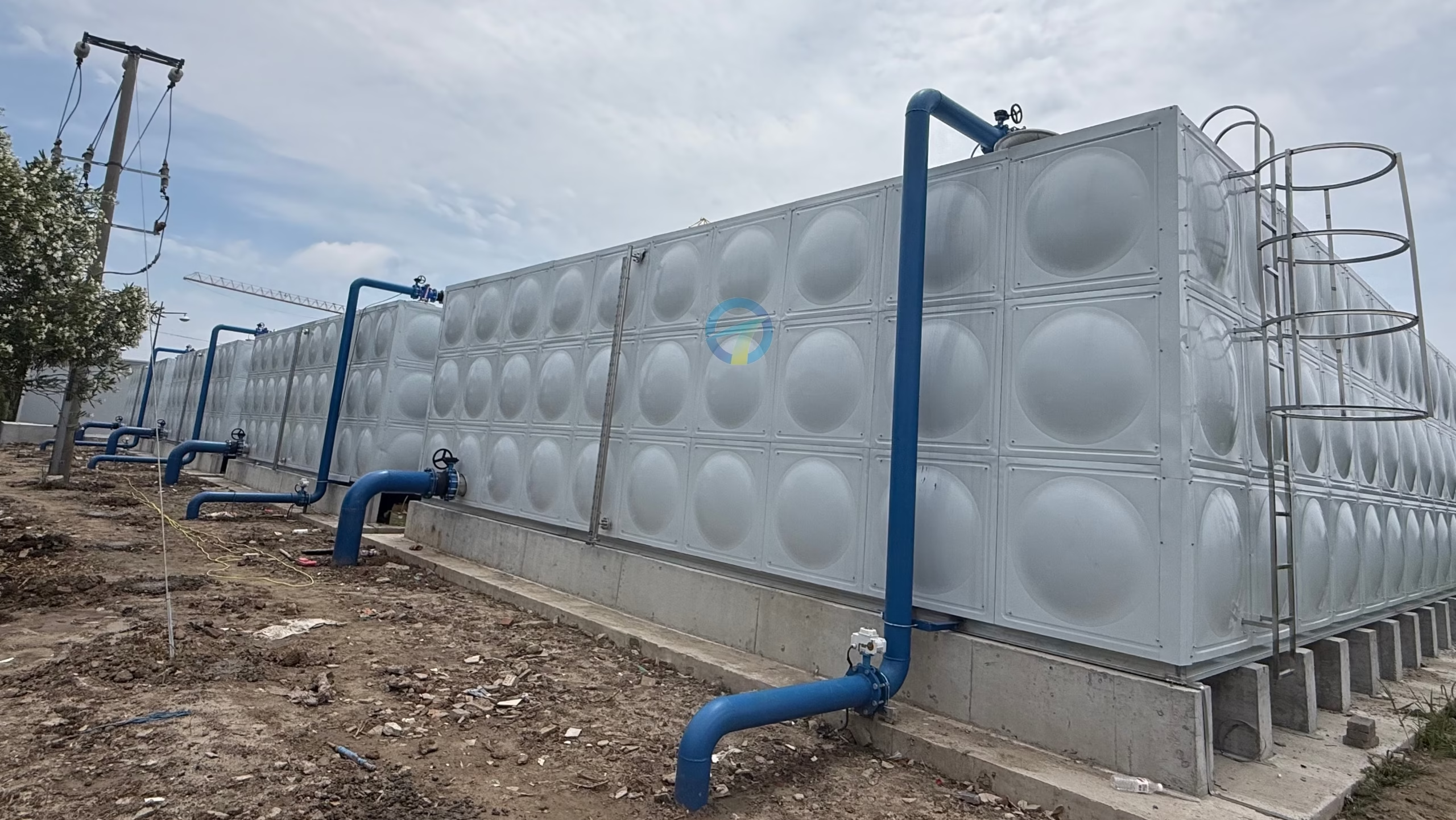
Stainless steel sectional water tanks Pressed embossed panels (common sizes 1 m ×1 m or 1 m ×0.5 m) use stepped thickness design: thinner sheets in upper rows, heavier panels along the base. Thickness normally ranges 1.5 mm up to 3 mm or higher, determined by water depth, panel dimension and reinforcement configuration. [Insert custom panel thickness table grouped by tank height here.] If a quotation quotes identical thickness for every wall panel, ask for the supporting structural calculations.
FRP/GRP sectional water tanks SMC moulded FRP panels gain structural stiffness from panel thickness, integrated ribs and flange geometry. Bottom panels feature thicker profiles or denser reinforcing ribs. [Insert FRP panel & rib specification table.] Since FRP has lower rigidity than stainless steel, precise base support layout becomes even more critical (see Section 7).
For both materials, wider, shallower tank layouts often deliver better value than tall narrow designs. Higher water depth amplifies pressure on bottom panels and increases reinforcement requirements.
3. Structural Reinforcement: Internal Tie Rods vs External Frames
Large bolted sectional tanks require reinforcement to counteract outward hydrostatic force from stored water.
Internal tie rods / stays: Reduce required panel thickness and cut project cost. For stainless steel tanks, tie rods must match the stainless grade of tank panels. Never mix galvanised or carbon steel components inside potable water tanks; mismatched metals trigger galvanic corrosion and water contamination. All rod penetration points need fully sealed fittings.
External reinforcement frames: Leave inner tank surfaces smooth. Smooth interiors simplify cleaning and reduce biofilm buildup, though this option increases material cost and site space requirements.
Where budget permits, most clients for drinking water systems prefer unobstructed inner walls. Internal stays remain widely accepted and cost-effective for fire water and industrial storage. Clearly specify your preferred reinforcement type in tender documents, so all suppliers quote against identical design scope.
4. Select Stainless Steel Grade Based On Water Chemistry: SS304 vs SS316 Chloride Limits
SS304 (18% chromium, 8% nickel) works as the standard grade for general potable water applications. SS316 contains molybdenum, delivering far stronger resistance against pitting and crevice corrosion when chlorides exist in the water. This rule of thumb should always be validated against formal water analysis reports.
| Operating Condition | Material Recommendation |
|---|---|
| Low-chloride potable water, inland sites | SS304 usually sufficient |
| High chloride levels, coastal atmosphere, brackish makeup water, heavy chlorination | SS316 / 316L recommended |
| Seawater or heavily saline process water | Stainless steel generally unsuitable; consider FRP or lined tank solutions |
Three often-overlooked risks for stainless steel tanks: Vapour zone corrosion is the main failure point. The area above the waterline collects condensation, concentrating salts and chloride ions. Even with mild bulk water quality, roof panels and upper wall sections corrode faster than permanently submerged surfaces. Coastal and hot humid projects benefit from SS316 for upper rows, roof panels or the whole tank.
Chlorine dosage needs careful management. Sustained high chlorine residual, or shock disinfection without full post-rinse, creates pitting corrosion on SS304 steel. Confirm the site’s planned chlorine operating levels early.
Always run water testing. Chloride concentration, pH, water temperature and disinfection method define the correct alloy grade. A simple water analysis sheet prevents costly disputes after tank installation.
5. Critical Fabrication Requirements for Stainless Steel Sectional Tanks
Weld surface treatment: Heat discoloration around weld joints weakens corrosion resistance. Require full pickling and passivation for stainless steel water tanks (per ASTM A380 / A967 standards) and request passivation records with delivery documents.
Flange and bolt specification: Fasteners must match the stainless grade in corrosive environments. Inspect gasket seating surfaces for flatness; minor surface distortion creates slow weeping leaks along panel seams.
Gaskets & sealant: Specify food-grade EPDM gasket or equivalent material, certified for potable water use for your target market. [Insert relevant certifications: NSF/ANSI 61, WRAS only if you hold valid certificates.]
Material traceability: Ask for mill test certificates verifying the actual steel grade. Substandard alloy substitution is common across the industry, and corrosion damage only appears months or years after commissioning.
6. Key Design Features for FRP/GRP Sectional Water Tanks
Resin & fibreglass laminate: FRP tanks for drinking water must use food-contact approved resin and laminates. Request market-relevant product certification and confirm panel manufacturing method, such as SMC compression moulding.
FRP SMC water tank light blocking design: Sunlight penetrates translucent panels and triggers algae growth inside stored water. Specify opaque, light-blocking panels, plus light-tight seals for roof and manhole joints.
Outdoor UV protection: Exterior FRP tanks require UV-resistant gel coat outer layers. Review warranty terms covering surface chalking and colour fading.
Thermal expansion allowance: FRP expands and contracts with temperature shifts. Joints, gaskets and pipe connections must accommodate thermal movement. Direct rigid pipe connections onto FRP panels can crack panels over time. Install flexible connectors for inlet, outlet and drain lines.
Fastener selection: Bolt material must suit site environmental conditions. Stainless steel fasteners are preferred in coastal and humid locations. Washers and backing plates directly affect load distribution across FRP panels.
7. Foundation & Tank Support Design
A full tank imposes uniform base load equal to water depth ×9.81 kPa. At 3.5 m water height, the base sees roughly 34 kPa load before adding tank dead weight. Always complete the sectional water tank foundation bearing capacity calculation using the fully filled tank condition, not empty tank weight.
Stainless steel sectional tanks typically rest on a reinforced concrete slab, supported by steel beam grids or concrete piers. Support beams must stay perfectly level; uneven support concentrates stress at panel joints and causes leakage.
FRP tanks have lower rigidity. Strictly follow the manufacturer’s specified support spacing and maintain flat bearing surfaces. Never use random isolated concrete blocks for makeshift support.
Where site layout allows, leave a minimum 500 mm clearance under the tank. This space enables visual inspection of bottom seams; undetected base leaks turn into the most expensive repairs.
Rooftop tank installations require structural engineer sign-off before final tank specification. Include wind loads, seismic forces and anchoring design for empty tank state.
8. Insulation & Temperature Control
High ambient temperatures in tropical regions speed up bacterial activity in stored water. Cold climates introduce freeze risk. Both stainless steel and FRP sectional tanks can be fitted with PU foam sandwich insulation panels. Insulation also minimises wall condensation, easing vapour zone corrosion covered in section 4. Fire water tanks in cold zones often need insulation, and some projects add heat tracing. Select insulation thickness based on local climate data.
9. On-site Cleaning & Commissioning
Stainless steel tanks: Avoid chlorine-based cleaners and steel wool scrubbers. Iron particles trapped on steel surfaces create rust spots and initiate pitting corrosion. Fully flush all disinfectants after sanitisation work.
FRP tanks: Skip abrasive cleaning tools that scratch inner surfaces. Scratches trap organic debris and encourage biofilm growth.
Before handover, complete a 24–48 hour hydrostatic leak test. Once passed, disinfect and flush the tank before putting it into service. Our related article covers recommended routine inspection schedules in greater depth.
Pre-Order Checklist
✅ Daily water demand, backup autonomy period and fire water volume documented
✅ Compartment layout agreed according to maintenance requirements
✅ Panel thickness per wall row provided with structural design basis
✅ Reinforcement style (internal tie rods / external frame) clearly defined
✅ Stainless alloy grade selected with water chemistry and vapour zone corrosion considered
✅ Bolts, gaskets and sealants matching material grade and holding required approvals
✅ Outdoor FRP panels with light blocking and UV resistant coating
✅ Foundation bearing load and support layout verified by qualified engineer
✅ Mill test certificates and passivation records included in delivery package
FAQ
Q: Is SS304 suitable for drinking water storage tanks? A: SS304 works well for inland sites with low-chloride raw water. For coastal locations, high chloride feedwater or frequent heavy chlorination, SS316 /316L delivers better corrosion resistance. Always carry out water analysis before final selection.
Q: Why do tank roof panels corrode faster than wall panels? A: Condensation forms in the vapour zone above water level, concentrating salt and chloride deposits. There is no continuous water flow to wash away these corrosive residues.
Q: Do FRP sectional tanks require ongoing maintenance? A: FRP itself will not rust. Even so, regular inspection of gaskets, bolts, panel joints and light barrier layers remains necessary.
Q: Can I combine stainless steel and galvanised fittings inside a potable water tank? A: Do not mix these metals inside drinking water tanks. Use all stainless steel fittings to prevent galvanic corrosion and water contamination.
Share your water analysis report, site layout and water demand data with our engineering team. We will prepare custom sectional tank layout drawings and a detailed quotation for your project.